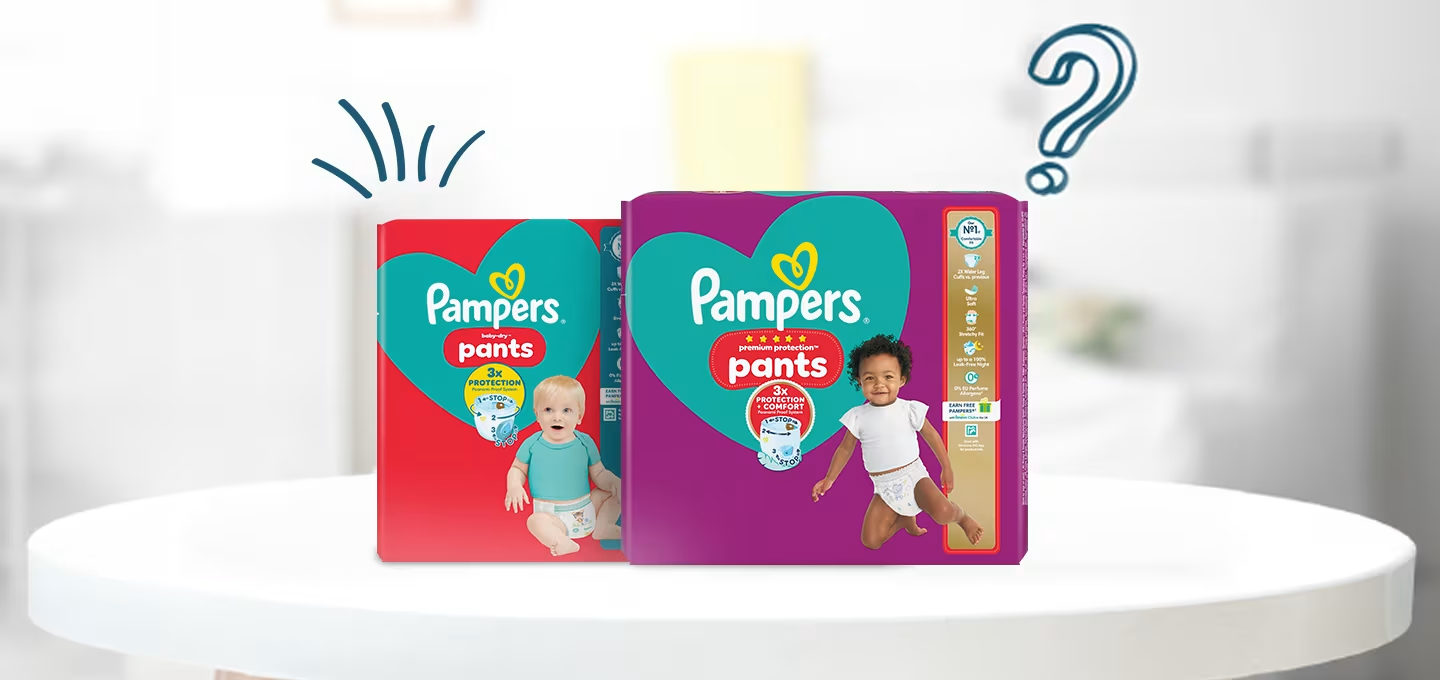
How to Use Pampers Nappy Pants


Key Takeaways
Remember changing your first nappy? If it seemed difficult the first few times, you probably soon got the hang of it - but now you might be finding it more of a challenge again as your baby becomes more active and wriggly.
If your little one no longer lies still for nappy changes, nappy pants could make life easier. In this article, you'll find a side-by-side comparison of nappy pants versus taped nappies, a guide to when to switch based on age and developmental milestones, and information on overnight protection. You'll also learn exactly how to put on, change, and dispose of nappy pants so the transition feels seamless.

What's the Difference Between Regular Nappies and Nappy Pants?
The main difference is how they fasten: regular nappies wrap around your baby's bottom and secure with adhesive side tapes, while nappy pants feature an all-round elasticated waistband that pulls up and down like underwear. This makes them ideal for active babies and toddlers who are less willing to lie still for a nappy change.
In fact, your child doesn't even have to be lying down to use nappy pants. Just encourage them to step into the leg openings, then quickly pull them up.
Here's how the two formats compare at a glance:
| Feature | Taped Nappies | Nappy Pants |
|---|---|---|
| How they fasten | Adhesive side tapes - wrap and stick | Elasticated 360° waistband - pull up like underwear |
| Best for | Newborns; babies who lie still; early nappy stages | Active babies and toddlers; babies who roll or crawl away |
| Ease of change | Requires baby to lie flat | Can be changed standing up - just tear the sides |
| Protection level | Up to 12 hours dryness; leak guards | Up to 12 hours dryness; 360° fit reduces waist and leg gaps |
| Night-time use | Yes - well established | Yes - Pampers Baby-Dry Nappy Pants designed for day and night |
| Available sizes | Size 0 (preemie) through size 8+ | Size 3 upward |
| Can you use both? | Yes | Yes - many parents use taped for some changes and pants for others |
There's no need to fully commit to one type. Many parents happily use both formats interchangeably - taped nappies for calm changes at home, and nappy pants for wriggly moments, active days out, or overnight wear.

Do Nappy Pants Protect as Much as Taped Nappies?
Yes! Nappy pants offer the same level of protection as taped nappies, with up to 12 hours of dryness and strong leak defence. The absorbency core is designed to perform to the same standard; the key difference is the pull-up format rather than the performance.
Pampers Baby-Dry Nappy Pants feature a Stop & Protect System with anti-leak cuffs around the legs and a Poo Pocket at the back to help contain messes as your baby moves. Combined with the 360° flexible waistband, these features help reduce the gaps that can cause leaks when a baby is crawling, standing, or sleeping.
If you're worried about switching, rest assured: protection isn't the trade-off. Whether you choose taped nappies or nappy pants, your baby gets the same reliable dryness - just in a format better suited to their stage.
Are Nappy Pants Good for Night-time Use?
Yes - nappy pants can be just as effective as taped nappies overnight, provided you choose a range designed for extended wear. Pampers Baby-Dry Nappy Pants offer up to 12 hours of all-round protection, making them well-suited to a full night's sleep.
Nappy pants can actually perform very well at night for a simple reason: the 360° flexible waistband fits snugly and moves with your baby as they shift position in their sleep, which helps reduce the gaps that lead to leaks. The Stop & Protect Poo Pocket at the back also helps contain any overnight surprises.
That said, taped nappies remain the appropriate format for very young babies or those not yet in size 3, as nappy pants aren't available in smaller sizes. And if you'd like to use pants during the day but stick with taped nappies at night while you build confidence, that's completely fine. Many parents run both formats side by side while finding what suits their baby best.
When Should I Switch from Nappies to Nappy Pants?
There's no hard and fast rule on when to make the switch - but a good sign your baby is ready is when they start rolling, wriggling, or crawling away during nappy changes. Many parents introduce nappy pants when their baby is around 6 to 9 months old, though every child is different.
Here's a helpful milestone-based timeline:
Is it after a few weeks? No - the switch isn't time-based; it's readiness-based. Most parents don't switch in the first weeks of a baby's life because nappy pants start at size 3 (from around 6 kg) and aren't available for newborns.
The good news is that trying nappy pants isn't a permanent commitment. You can trial a pack whenever you feel ready and switch back to taped nappies at any point if they suit your routine better. Read more on when it's the right time to switch to nappy pants.
What Age Should I Start Using Nappy Pants?
There's no single correct age to start using nappy pants - but in practice, most babies are ready from around 6 months, once they're in size 3 (approximately 6–10 kg). That's the smallest size in which Pampers nappy pants are available.
A helpful rule of thumb for when to buy your first pack: once your baby has reached size 3 in taped nappies and is starting to roll or resist lying still, that's a natural moment to try a pack of pants alongside your usual nappies. You don't need to make a full switch - just introduce them gradually and see how your baby takes to them.
As with newborn nappies, avoid overbuying before you've tested them. Start with a small trial pack to check the fit and comfort before stocking up. For a full weight-based size check, take a look at the Pampers nappy size and type guide.
How to Change Pampers Nappy Pants
If your baby seems ready to try them and you're wondering how to use nappy pants, check out these step-by-step instructions to discover how easy it is to change them:
1) Remove the Nappy Pants

Just tear both sides of the nappy pants and, keeping the mess at the bottom of the nappy, slide the pants out from between your baby's legs.
2) Roll Them Up

3) Tape Them Up

Nappy pants have a tape on the backside that you can use to secure the rolled-up nappy, then simply throw it away.
Clean as Usual

Gently clean your baby's bottom as you usually would when changing regular nappies. Learn more about choosing the best baby wipe to clean and care for your baby's skin.
Pop on a Fresh Pair of Nappy Pants

Pull on a fresh pair of nappy pants – the soft and stretchy waistband makes it easy to pop them on, no matter how wriggly your baby is. There you go, all done!
More Changing Tips for Active Babies
Here are a few more tips for nappy changes with an active, energetic baby or toddler:
Choosing the Right Size Pampers Nappy Pants
When switching from regular nappies to nappy pants, you might be wondering whether the sizing is different. Pampers nappy pants are available from size 3 upwards, and usually your little one is likely to need nappy pants the same size as the regular nappies you're already using.
A perfectly fitting nappy or nappy pant is important for comfort and preventing leaks and blowouts. If you're not sure what size nappy pants are best for your baby or whether your current nappy fits right, follow these handy tips:
WHAT'S MY BABY'S NAPPY SIZE?
Nappy Size Calculator
Find out your baby's nappy size, how many nappies you'll need per day and for how long:
FAQS AT A GLANCE
It differs for every child, but many parents switch to nappy pants when their baby is 6 to 9 months old. A tell-tale sign that your little one is ready for nappy pants is if he or she starts to roll or wriggle away during a nappy change.
The Bottom Line
If changing your increasingly active baby is a bit of a challenge these days, consider switching to nappy pants. They give your little one the freedom to move about and explore the world while providing maximum protection against leaks - the same reliable dryness as taped nappies, just in a pull-up format. For overnight use, ranges like Pampers Baby-Dry Nappy Pants offer up to 12 hours of protection, so you can use them day and night once your baby reaches size 3.
And, as you can see from this step-by-step guide, they're easy to change while your baby is wriggling, trying to crawl away from you or even standing up. Just tear the sides of the old pair, roll and tape them up. Then, after cleaning your little one's bottom, pull on a new pair and you're good to go! For a full comparison of the range, see our guide to which Pampers nappy to choose.
Read more about Safety and Commitment
Tips for Changing a Crawling Baby’s Nappy
If your baby likes to wriggle and squirm while changing their nappy, we have some tips to keep them distracted and make nappy changing much easier.
Read more
Tips for Changing an Active Baby on the Go
If you're worried about having to change a nappy whilst travelling with your little one, we have some great tips on how to make this a stress-free task.
Read more
Potty Training Boys: Helpful Tips and Encouragement for Parents
Find tips and guidance for potty training boys. Learn how to support your child's progress with patience and encouragement. Read the full guide now.
Read moreTips for Changing a Crawling Baby’s Nappy
If your baby likes to wriggle and squirm while changing their nappy, we have some tips to keep them distracted and make nappy changing much easier.
Read moreTips for Changing an Active Baby on the Go
If you're worried about having to change a nappy whilst travelling with your little one, we have some great tips on how to make this a stress-free task.
Read morePotty Training Boys: Helpful Tips and Encouragement for Parents
Find tips and guidance for potty training boys. Learn how to support your child's progress with patience and encouragement. Read the full guide now.
Read moreJoin Pampers Club and get:
- PAMPERS COUPONS
- TOOLS & QUIZZES
- PARENTING TIPS
 PAMPERS COUPONS
 TOOLS & QUIZZES
 PARENTING TIPS