4 Months Pregnant: Symptoms and Foetal Development
Being four months pregnant is an eventful time. You’re in the second trimester now and some call in the ‘honeymoon stage’ of pregnancy. You may experience a welcome energy boost and some of those pesky early symptoms may be wearing off, for example. Read on to find out more about the changes you might experience and how your little one is developing this month.
Key Takeaways
Symptoms at 4 Months Pregnant
As you enter the second trimester, a few of the early symptoms of pregnancy may be subsiding, although some may linger for a little while longer. Meanwhile, new symptoms may be appearing. Although you might not experience all of them, here are some of the more common pregnancy symptoms at four months pregnant:
Your Baby’s Development at 4 Months
When you’re four months pregnant, your foetus’s facial muscles can move, although any expressions are random. The eyes aren’t open yet, but they are sensitive to light. The ears are also working. This means your little one may be able to sense bright lights outside your belly and hear the sound of your heart, and even your voice. Now is a great time to start bonding by singing or talking out loud to your bump. This isn’t all that’s going on inside your belly at four months pregnant. Your foetus’s ovaries (if she’s a girl) or testicles (if he’s a boy) are now fully developed inside his or her body, and it won’t be long before the external genitals are visible too, so you may soon be able to find out whether you’re having a boy or a girl, if you wish. You could ask for this information at the second ultrasound scan, which is usually offered at around 20 weeks of pregnancy. Keep in mind that gender predictions made during an ultrasound scan are not always reliable. Added to this, your foetus may not be lying in a position where the sonographer can easily get a clear view of what’s between his or her legs. Also, be aware that the main purpose of the scan is to monitor foetal development and screen for abnormalities, so the sonographer may not be able to devote too much time to finding out his or her sex. Some hospitals have a policy of not disclosing gender predictions at all. So, if you’re keen to know, it’s best to ring ahead and check that you’ll be able to ask for this information. Until then, there’s still time to add a few more suggestions to your lists of girl names and boy names, or maybe hedge your bets by considering some unisex names as well.
How Big Is Your Baby When You’re 4 Months Pregnant?
At the start of this month, your foetus is about the size of a nectarine, measuring close to 8.5 centimetres, crown to rump. Toward the end of the month, your foetus is around the size of a sweet potato, measuring about 14 centimetres from crown to rump and weighing around 190 grams.
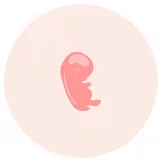
What Does a Foetus Look Like at 4 Months?
Check out these illustrations for a glimpse at what your foetus might look like when you’re four months pregnant:

Now that you’re in the second trimester of your pregnancy, you may start to feel a little better as the symptoms of early pregnancy start to ease up. In fact, this stage is often referred to as the ‘honeymoon’ of pregnancy, as many mums-to-be enjoy a burst of energy and start to ‘glow’ around this time. Every pregnancy is different, however, so don’t be surprised if your early pregnancy symptoms seem to be hanging around for a bit longer. At around four months pregnant your little one is receiving all his or her oxygen and nutrients from your placenta, via the umbilical cord. Those nutrients come from the things you eat, so you really are ‘eating for two’, but – perhaps surprisingly – this doesn’t apply to the number of calories you need to consume. In fact, there’s usually no need to eat any more food than usual at four months pregnant. Quality over quantity is a good maxim when it comes to eating while you’re pregnant: Keeping to a healthy, balanced diet is the most important part of ensuring that your little one gets all the nutrition, vitamins and minerals he or she needs to grow and develop into a healthy baby. Keep in mind that not all foods are safe during pregnancy. For example, certain cheeses, pâtés, raw or undercooked meats, liver and some cold cured meats should stay off the menu for now. Read more about what not to eat when pregnant.
How Far Along Are You at 4 Months Pregnant?
You may be finding it tricky to work out how many weeks along you are at four months pregnant, or vice versa, and that’s hardly surprising: The weeks of pregnancy don’t fit neatly into months, so there’s no hard and fast conversion method. As a rough guide, though, the fourth month of pregnancy covers from 14 to 18 weeks of your pregnancy.
FAQs at a Glance
At four months pregnant, your baby can certainly move, so if you haven’t felt it already you’re likely to experience those first swirling or fluttering movements in your belly in the next few weeks or so.
Precisely when this happens varies a lot, but most mums-to-be feel the first movements by around 24 weeks. If you haven’t felt anything by then, tell your doctor or midwife who’ll be able to check your little one’s movements and heartbeat for you.
Checklist for When You’re 4 Months Pregnant
4 Months Pregnant - checklist
5 Months Pregnant: Symptoms and Foetal Development
At five months pregnant, you might have your 20-week scan when you’ll finally get another peek inside your bump. Learn more about this exciting month here.
Read more
6 Months Pregnant: Symptoms and Foetal Development
Embark on the journey of the 6th month of pregnancy, understanding the rapid developments of your baby and learning about 6-month pregnancy milestones.
Read more
9 Months Pregnant: Symptoms and Foetal Development
At nine months pregnant, you’re almost at the end of your pregnancy journey. Learn how your foetus’s position can impact how you give birth.
Read more
8 Months Pregnant: Symptoms and Foetal Development
Find out how your foetus is developing and what’s in store for you at eight months pregnant. And learn about your foetus’s position as you near your due date.
Read more
1 Month Pregnant: Symptoms and Foetal Development
Navigating the early stages of a 1-month pregnancy? Uncover the key changes & symptoms occurring with comprehensive information and guidance.
Read more
7 Months Pregnant: Symptoms and Foetal Development
At seven months pregnant, many of your symptoms could be related to your growing belly size. Learn more here!
Read more
2 Months Pregnant: Symptoms and Foetal Development
Learn about some common symptoms at two months pregnant, and how the embryo is growing and developing inside your belly this month.
Read more
3 Months Pregnant: Symptoms and Foetal Development
At three months pregnant, you’re in the final stretch of the first trimester. Find out what kinds of things may be in store for you and your foetus this month.
Read more5 Months Pregnant: Symptoms and Foetal Development
At five months pregnant, you might have your 20-week scan when you’ll finally get another peek inside your bump. Learn more about this exciting month here.
Read more6 Months Pregnant: Symptoms and Foetal Development
Embark on the journey of the 6th month of pregnancy, understanding the rapid developments of your baby and learning about 6-month pregnancy milestones.
Read more9 Months Pregnant: Symptoms and Foetal Development
At nine months pregnant, you’re almost at the end of your pregnancy journey. Learn how your foetus’s position can impact how you give birth.
Read more8 Months Pregnant: Symptoms and Foetal Development
Find out how your foetus is developing and what’s in store for you at eight months pregnant. And learn about your foetus’s position as you near your due date.
Read more1 Month Pregnant: Symptoms and Foetal Development
Navigating the early stages of a 1-month pregnancy? Uncover the key changes & symptoms occurring with comprehensive information and guidance.
Read more7 Months Pregnant: Symptoms and Foetal Development
At seven months pregnant, many of your symptoms could be related to your growing belly size. Learn more here!
Read more2 Months Pregnant: Symptoms and Foetal Development
Learn about some common symptoms at two months pregnant, and how the embryo is growing and developing inside your belly this month.
Read more3 Months Pregnant: Symptoms and Foetal Development
At three months pregnant, you’re in the final stretch of the first trimester. Find out what kinds of things may be in store for you and your foetus this month.
Read more