
Fine Motor Skills in Babies and Toddlers


You might have heard of fine motor skills and be wondering what exactly they are, why fine motor skills are important and how you can support your child's development in this area. Read on to find out what fine motor skills are and how they develop as your child gets older. You’ll also find some examples of activities that can help develop your baby or toddler’s fine motor skills based on his or her age.
What Are Fine Motor Skills?
Fine motor skills – sometimes also known as ‘hand and finger skills’ – are the ability to coordinate movements of those small muscles in the wrists, hands and fingers. They’re important for things like buttoning up clothes, using scissors, writing, tying shoelaces, eating, picking up and handling small objects and all the other ‘fiddly’ tasks that you probably take for granted. Even though these movements probably come completely naturally for you, your child will spend the first few years of his or her life learning how. You might have heard of gross motor skills, these are the ability to coordinate the large muscle movements of the arms, legs, and feet, as well as the ability to balance and control the entire body. You can encourage your child’s fine motor skills development through various activities and play depending on his or her age. We’ll give you some concrete examples on what to try in the next sections. Remember that since each child develops at his or her own pace, the development of your child's fine motor skills may happen earlier or later when compared to another child. If you’re ever worried or have any questions about your child’s development, talk to your health visitor or doctor.
Fine Motor Skills in the First 3 Months
In the first few weeks most of your newborn baby’s movements will seem random, but your infant can already grip onto your finger with his or her fingers or toes. This is just one of the many reflexes your child is born with. Others include turning towards your breast and sucking when hungry or making stepping movements if you hold your infant upright on a flat surface. Most of these reflexes (except sucking) disappear after a few months, but by then your baby’s fine motor skills will be developing apace. You’ll need to be careful during this time, because these movements are reflexive your newborn could release at any moment – that’s why you should never hold your baby up with just her hands curled around your finger, for example.
By 3 Months old, your baby will likely be able to:
How to Help Develop Your 1- to 3-Month-Old's Fine Motor Skills
To encourage the development of these fine motor skills, show your little one toys that stimulate various different senses. As your baby starts getting the hang of controlling the finger and hand muscles, he or she will reach out and explore them by touch. Toys that could help your baby’s development at this stage include:
In Summary
By around 3 months old your baby will be able to open and close the hands, bring a hand up to his or her mouth and swipe for objects dangled nearby. Help d
Fine Motor Skills at 3 to 6 Months Old
Between the ages of 3 and 6 months old, your infant will keep developing those fine motor skills, becoming more dextrous as the weeks and months pass by. By 6 months old your baby will probably be
Fine Motor Skills Activities for Your 3- to 6-Month-Old Baby
In Summary
Examples of your baby’s fine motor skills at around 6 months old might include grasping objects, shaking them and banging them against a surface. You might also notice your baby picking things up with a raking motion.

Fine Motor Skills at 6 to 12 Months
Between 6 months and 1 year of age, you could start to discover one of the more challenging aspects of your child’s newfound fine motor skills. For example, your baby may want to put everything in his or her mouth. As a part of baby proofing your home, you’ve probably already cleared away any small objects that could be a choking hazard or could be dangerous if your child ingests it – but just to be on the safe side it might be worth doing another sweep of the house, paying close attention to anything that’s within your baby’s reach. There’s an upside to this, of course: Your little gourmet will be able to eat finger foods and hold a cup as he or she makes the transition from breast milk or formula to solid food.
By 12 months old your child will usually be able to
Fine Motor Skills Activities for Your 6- to 12-Month-Old
Here are just a few examples of activities for your 6- to 12-month-old to help improve fine motor skills:
In Summary
By 12 months your child will be perfecting the ‘thumb-and-finger pinch’, banging objects together, dropping them on the floor, and putting things into boxes and taking them out again. Action songs, finger painting and having fun with water and sand are great activities to encourage the development of those fine motor skills.
Fine Motor Skills at 1 to 2 Years Old
If it hasn’t happened already, it won’t be long before your child takes those first tentative steps. As your toddler becomes more mobile, you’ll probably find your little one is always poking fingers into holes and taking items down from shelves and out of cupboards, drawers and containers. All that exploration will bring plenty of opportunities to hone those fine motor skills even more. For you, this is the time to do another round of child proofing to ensure any cupboards or shelves your toddler can reach only have safe items in them. Any other cupboards should have childproof locks on them. Move unsafe items that can’t be locked away on to a high shelf that’s completely out of reach of your toddler.
By 18 months, your toddler will probably be able to
By 2 years old your child may be able to
Fine Motor Skills Activities for Your 1-Year-Old
As your toddler gets older, you could try the following activities to help develop essential hand and finger skills:
In Summary
By 12 months your child will be perfecting the ‘thumb-and-finger pinch’, banging objects together, dropping them on the floor, and putting things into boxes and taking them out again. Action songs, finger painting and having fun with water and sand are great activities to encourage the development of those fine motor skills.

Fine Motor Skills at 2 to 3 Years Old
Although this period is sometimes known as the terrible twos, it really isn't all that terrible when you think about all the progress your child’s making with those fine motor skills and other abilities.
Between 2 and 3 years old your toddler will likely learn to
Fine Motor Skills Activities for Your 2-Year-Old
By now your child's ability to focus will be much improved, so he or she will be able to concentrate for longer on creative tasks. Some examples of fine motor skills activities for your 2-year-old include:
In Summary
Between the age of 1 and 2 years old your child will be getting better at using those little hands and fingers to stack things and manipulate objects using both hands in a coordinated way. Encourage two-handed activities to help your toddler practice these fine motor skills.
Fine Motor Skills at 3 to 4 Years Old
At 3 years old, your child will have a greater degree of muscular control, and this will be reflected in his or her fine motor skills. You might notice this in the way your budding scribe’s grip on a pencil or crayon changes during this period – from a fist-like clench to a more adult-like hold using the thumb, index and middle fingers. This is also the year when your 3-year-old may develop a clear preference for using the right or left hand. When this happens, your child will mostly use this dominant hand to pick things up. Some fine motor skills your child is likely to gain between 3 and 4 years old:
Fine Motor Skills Activities for Your 3-Year-Old
Your 3-year-old may already love scribbling and making marks on things, so provide plenty of opportunities to draw with all sorts of different writing implements such as pencils, crayons, chalk, paintbrushes and more. Vary the texture and position of the drawing surface. For example, one day you could use a vertical black/whiteboard or just a sheet of paper masking-taped to the wall. On another – if the weather’s nice – let your budding artist use chalks to decorate the pavement, your garden path or driveway. Using child-safe scissors to cut paper or other materials like fabric and card is another fun activity that helps your 3-year-old develop fine motor skills. Under your close supervision, your child could lend a hand with safe household tasks. These are some examples of safe activities that help develop the fine motor skills of a 3-year-old:
In Summary
Your 2-year-old’s hand and finger skills will continue to improve as he or she learns to draw lines with a pencil or crayon, turn the pages of a book and turn handles, knobs and levers.
Fine Motor Skills at 4 Years Old
At 4 years old, your child is well on the way to having fully developed hand and finger skills. From the age of 4 upwards, your little one will learn to do all this and more:
Fine Motor Skills Activities for Your 4-Year-Old
Keep doing all the things listed above, increasing the difficulty as your child gets better at them. Sometime after the age of 4 your child will learn how to draw the basic shapes – lines, circles, squares and crosses – that will eventually form letters when he or she learns to write. These shapes are often learned in the following order:
Some more activities to engage your 4-year-old’s fine motor skills:
In Summary
Your 3-year-old may soon learn to hold a pencil between the thumb index and middle fingers. It’s also around this time that you could find out whether your little one is left or right-handed.
FAQS AT A GLANCE
Fine motor skills are the ability to precisely control the muscles of the hand, fingers and wrist. Gross motor skills enable your child to control large muscles such as those in the arms, legs and feet.
The Bottom Line
Fine motor skills are essential for our daily tasks – the ones we often take for granted, like getting dressed, tying shoelaces, and typing an email. Encouraging playtime activities isn't just about fun. Play also helps your baby, toddler or older child master the fine motor skills (and other skills) that he or she will need each and every day throughout life. For more tips on playing with your baby, see our article on baby games in the first year. If you’re looking for ways to keep your toddler or older child entertained and busy, check out our list of indoor games and activities for toddlers.

Understanding Parallel Play in Toddlers
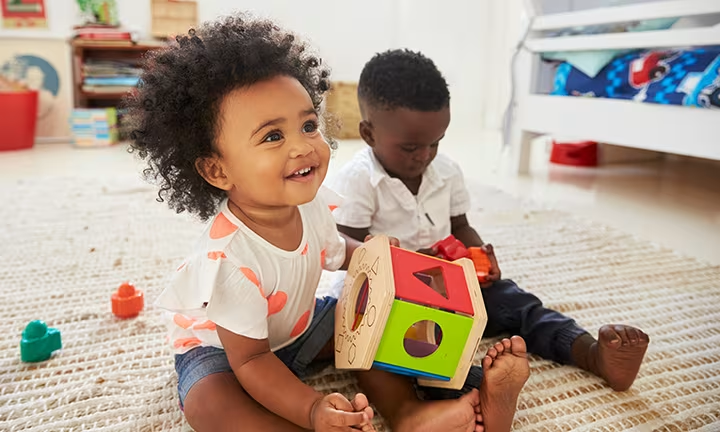
Unlike older children, toddlers tend to play alongside each other but don’t interact. This is called parallel play. Read about this stage of play development.
Read more
All About Thumb-Sucking
Thumb or finger-sucking is normal in the first few years. Learn why your child sucks his or her thumb and if you should help your little one break the habit.
Read more
Toddler milestones: developing independence
Aiding your toddler in gaining independence will both help them in their coming years, as well as reducing any separation anxiety that they may be feeling.
Read more
10 Tips for Dealing With the Terrible Twos
Discover the meaning behind the term ‘terrible twos’, what causes it and how long it lasts. Plus, get tips for dealing with the tantrums and defiant behaviour.
Read more
What Is Pretend Play?
Pretend play is an important developmental stage for toddlers. It enables your child to boost language and social skills through play. Read more about imaginative play.
Read more
Is My Child Ready For Nursery School?
Is your child ready to move to nursery school? Find out using our useful guide about the best age to send your child to nursery school.
Read moreUnderstanding Parallel Play in Toddlers
Unlike older children, toddlers tend to play alongside each other but don’t interact. This is called parallel play. Read about this stage of play development.
Read moreAll About Thumb-Sucking
Thumb or finger-sucking is normal in the first few years. Learn why your child sucks his or her thumb and if you should help your little one break the habit.
Read moreToddler milestones: developing independence
Aiding your toddler in gaining independence will both help them in their coming years, as well as reducing any separation anxiety that they may be feeling.
Read more10 Tips for Dealing With the Terrible Twos
Discover the meaning behind the term ‘terrible twos’, what causes it and how long it lasts. Plus, get tips for dealing with the tantrums and defiant behaviour.
Read moreWhat Is Pretend Play?
Pretend play is an important developmental stage for toddlers. It enables your child to boost language and social skills through play. Read more about imaginative play.
Read moreIs My Child Ready For Nursery School?
Is your child ready to move to nursery school? Find out using our useful guide about the best age to send your child to nursery school.
Read moreUnderstanding Parallel Play in Toddlers
Unlike older children, toddlers tend to play alongside each other but don’t interact. This is called parallel play. Read about this stage of play development.
Read moreAll About Thumb-Sucking
Thumb or finger-sucking is normal in the first few years. Learn why your child sucks his or her thumb and if you should help your little one break the habit.
Read moreJoin Pampers Club and get:
- PAMPERS COUPONS
- TOOLS & QUIZZES
- PARENTING TIPS
 PAMPERS COUPONS
 TOOLS & QUIZZES
 PARENTING TIPS