Eco-Friendly Nappy Checklist: Materials, Certifications & Disposal Reality Check


Key Takeaways
Wondering what actually sits against your baby’s skin is a completely reasonable question, especially when you’re changing a dozen nappies a day and trying to make the best choice you can. Yet walking down the nappy aisle - or scrolling online - often feels less clarifying than confusing. Labels promise “eco,” “natural,” “plant-based,” and “biodegradable,” but very few of these terms are independently verified, and each can mean quite different things in practice.
The difference between a genuinely lower-impact nappy and a well-marketed one usually comes down to a handful of certifications, a clear understanding of materials, and some honesty about what happens after disposal. Marketing language alone rarely tells you whether a nappy is safer for your baby or better for the planet.
In this article, we’ll cut through the claims to explain what nappy materials and certifications actually mean, look at the biodegradability reality, and help you make an informed, confident choice for your baby and the environment.
What Are Eco Nappies Made Of? Materials Explained
Eco nappies are typically made by replacing some of the petroleum-based plastics found in standard disposables with plant-derived alternatives such as bamboo viscose, organic cotton, corn-based bioplastic (PLA), or FSC-certified wood pulp - though most still contain superabsorbent polymer (SAP) for effective absorbency.
Standard Disposable Nappies - Core Materials
A standard disposable nappy is engineered from a small set of core components, each with a specific job. According to Pampers’ own materials disclosure, the main ingredients are superabsorbent polymer (SAP), elemental chlorine-free (ECF) cellulose pulp, polypropylene (used for the topsheet), polyethylene (used for the backsheet), elastane, adhesives, and polyester.
SAP is the gel-forming polymer that locks moisture away from the skin, and it is used across the industry - including in most eco-branded nappies. Polypropylene and polyethylene are petroleum-derived plastics, and they are what give conventional disposables their strength, softness, and - unfortunately - their very long landfill lifespan.
For a fuller breakdown, see our guide on What’s in a Pampers nappy or our overview of Materials and safety.
Eco Nappy Materials - What's Different
Eco nappies substitute some or all of the petroleum-based plastics with plant-derived alternatives, most commonly bamboo viscose, organic cotton, corn-based (PLA) bioplastic, or FSC-certified wood pulp for the absorbent core. Most eco nappies still contain some SAP for effective absorbency, and small amounts of conventional plastic often remain in elastic tabs, fastening tapes, or the backsheet - meaning very few are 100% plant-based in practice.
It’s worth remembering that “plant-based” on its own is a materials claim, not a certification. A natural material is not automatically safer or lower in harmful residues; third-party testing and independent certification are the meaningful differentiators.
Eco Nappies vs Standard Nappies: How Do They Compare?
Eco and standard nappies differ mostly in the materials used for the topsheet, backsheet, and core sourcing, along with typical certifications and price - but their environmental end-of-life story is more similar than marketing suggests.
| Feature | Standard Disposable Nappy | Eco / Greener Disposable Nappy |
| Topsheet | Typically polypropylene (petroleum-based) | Often plant-based (bamboo, cotton, PLA) |
| Core / absorbent layer | SAP + ECF wood pulp | SAP + FSC-certified wood pulp (common) |
| Backsheet | Polyethylene plastic | May use bio-based plastic alternatives |
| Chlorine bleaching | ECF (elemental chlorine-free) standard | ECF or TCF (totally chlorine-free) |
| Chemical certifications | Varies by brand | OEKO-TEX Standard 100 (if certified) |
| Biodegradability in landfill | Up to 500 years | Still decades to centuries - depends on conditions |
| Environmental sourcing | Varies | FSC-certified wood pulp (if labelled) |
| Price | Lower (typically £0.10–0.18/nappy) | Higher (typically £0.20–0.35/nappy) - estimated ranges |
| Fragrance-free options | Available | Common |
The comparison above reflects typical market offerings, but individual products vary considerably - some mainstream nappies hold the same OEKO-TEX Standard 100 certification as eco-branded options, while some eco nappies may lack independent testing entirely. Rather than assume all eco-labelled nappies share the same credentials, check the specific certifications, materials, and disposal information of any nappy you’re considering. For help matching stage and fit, our Pampers nappy size and type guide is a useful starting point.
I'm Looking for Nappies Free From Harmful Chemicals - What Should I Choose?
If you want nappies free from harmful chemicals, the most reliable approach is to choose products carrying independent chemical safety certification - specifically OEKO-TEX Standard 100 (Class I for baby products) - combined with fragrance-free, chlorine-bleach-free, and latex-free labelling. Certification, not marketing language, is what verifies safety.
What "Harmful Chemicals" Actually Means in Nappy Context
The substances parents most commonly want to avoid in nappies include chlorine-based bleaching agents (which can produce dioxin by-products), phthalates, formaldehyde, heavy metals such as lead and cadmium, parabens, added fragrances, and latex. Not all of these are present in standard nappies, and UK and EU regulations already impose safety limits on many of them.
It’s also worth noting that the phrase “chemical-free” is not scientifically meaningful - every material, natural or synthetic, is made of chemicals. The useful question is whether harmful substances are present above safe thresholds, and independent third-party certification is the only reliable way to answer that.
What to Look for When Choosing a Lower-Chemical Nappy
The single most meaningful indicator of chemical safety is OEKO-TEX Standard 100 certification. This standard independently tests every component of a nappy - including threads, adhesives, and dyes - against more than 1,000 regulated and non-regulated substances, with stricter limits applied to Class I products intended for babies and children under 3. Certification is renewed each year, so a certified product must be retested annually.
Alongside certification, look for reassuring product-level claims that can be independently verified: fragrance-free, chlorine-bleach-free (ECF or TCF), latex-free, and EU 26 allergen-free. You can learn more in our guide to What’s in a Pampers nappy.
What Are the Least Toxic Baby Nappies on the Market?
The least toxic baby nappies are those with independently verified chemical safety credentials - most notably OEKO-TEX Standard 100 (Class I) certification - combined with fragrance-free, latex-free, and chlorine-bleach-free formulations. No disposable nappy is entirely without an environmental or chemical footprint, but third-party testing gives you the strongest evidence available today.
The Certifications That Signal Lower Harmful Substance Levels
The nappies with the strongest third-party evidence of low harmful substance levels are those certified to OEKO-TEX Standard 100 in Class I, the strictest category for products used by babies under 3. This matters because a baby’s skin is thinner and more permeable than adult skin, so lower substance limits are applied to help account for that difference.
FSC certification, by contrast, addresses the sustainability of wood pulp sourcing, not the chemical safety of the finished nappy. Both certifications matter, but they serve different purposes and are not interchangeable. A nappy that is “dermatologically tested” has been assessed for skin irritation - but the scope and rigour of such testing varies significantly by brand and is not equivalent to OEKO-TEX Standard 100 chemical screening.
What "Least Toxic" Does Not Guarantee
Even the most rigorously certified disposable nappy is not “zero impact.” OEKO-TEX Standard 100 confirms that harmful substances are below established safety limits, not that they are entirely absent. Certification also does not extend to biodegradability, and it does not guarantee that your baby’s skin will react favourably - every baby is different.
If your baby has persistent nappy rash or a skin reaction that does not settle with usual care, speak to your health visitor or GP regardless of the nappy brand you are using. Our guide on Nappy rash: causes and treatment may also help.
Are Eco Nappies Better for My Baby's Skin Than Regular Nappies?
Not necessarily - an eco label alone does not guarantee a nappy is better for your baby’s skin. What matters more is whether the specific product carries independent skin-safety certification (such as OEKO-TEX Standard 100) and is free from common irritants like added fragrances, latex, and chlorine bleaching agents.
Baby skin is genuinely different from adult skin. The outer skin layer can be up to 30% thinner than an adult’s at birth and continues to develop over the first months and years, making it more sensitive to prolonged moisture, potential allergens, and friction. Choosing a well-fitting, well-tested nappy and changing it promptly - see our guide on How to change a nappy for a refresher - matters as much as the material composition.
Both standard and eco nappies can be formulated for sensitive skin and can hold the same independent certifications. Some eco nappies use materials that can occasionally trigger reactions in a small number of babies - bamboo viscose is generally well tolerated, but latex, which sometimes appears in eco elastic components, is a known allergen for some. In practice, look for the certification and the fragrance-free, allergen-free credentials rather than the “eco” label alone.
If your baby develops persistent nappy rash or an unexplained skin reaction, speak to your health visitor for tailored advice.
What Do Nappy Certifications Like OEKO-TEX and FSC Actually Mean?
Nappy certifications each test something specific - OEKO-TEX Standard 100 verifies chemical safety, FSC verifies the sustainability of wood pulp sourcing, and ecolabels like the Nordic Swan cover broader environmental production impact. Understanding what each certification covers - and does not cover - helps you cut through marketing language.
OEKO-TEX Standard 100 - Chemical Safety
OEKO-TEX Standard 100 independently tests every component of a textile or absorbent product - including threads, adhesives, and dyes - against more than 1,000 regulated and non-regulated harmful substances. For baby products in Class I (under 3 years), the limits are stricter than for adult products.
It covers heavy metals, pesticide residues, phthalates, formaldehyde, azo dyes, allergenic dyes, pH, and (since 2024) PFAS - the so-called “forever chemicals.” What it does not cover is the environmental impact of production, biodegradability, or the sustainability of raw material sourcing. Certification is renewed annually, meaning a certified product must be retested each year to keep its label.
FSC (Forest Stewardship Council) - Sustainable Sourcing
FSC certification confirms that the wood pulp used in a nappy’s absorbent core comes from responsibly managed forests - forests assessed for biodiversity, worker rights, and long-term regeneration. It is a sourcing assurance, not a chemical safety test. What it does not cover is the chemical safety of the finished nappy or what happens to that nappy after disposal.
Other Certifications to Know
Nordic Swan Ecolabel and EU Ecolabel are life-cycle environmental certifications covering production impact, and are more comprehensive on sustainability than OEKO-TEX - but they are less widely held by mainstream UK nappy brands. “Dermatologically tested” indicates a skin irritation assessment has been carried out, but the scope varies by brand and is not equivalent to OEKO-TEX Standard 100 chemical screening. “Natural” and “plant-based” are marketing descriptors, not independently verified certifications.
Are Eco Nappies Really Biodegradable? The Disposal Reality
No mass-market disposable nappy - eco-branded or standard - is fully biodegradable in normal UK landfill conditions. Biodegradation requires oxygen, moisture, and active microorganisms, and sealed modern landfill sites reliably provide none of these. Claims of “up to 60% biodegradable” refer to material composition, not to what actually happens after disposal.
The scale of the challenge is significant. According to written evidence submitted to the UK Parliament by the Nappy Alliance, approximately 3.6 billion single-use nappies are sent to UK landfill or incineration every year. These make up around 8% of residual household waste in England, and disposal costs local authorities over £140 million annually.
A standard disposable nappy in landfill can take up to 500 years to decompose. Eco nappies containing biodegradable materials will not break down within their marketed timeframe once compressed under subsequent waste layers, where oxygen and microbial activity are severely limited. In some cases, faster-degrading eco nappy materials can actually release methane - a more potent greenhouse gas than carbon dioxide - more rapidly than conventional nappies in landfill, according to the UK’s National Atmospheric Emissions Inventory.
If overall environmental impact is your priority, reusable cloth nappies remain the most evidence-backed low-impact option. The Environment Agency’s life-cycle assessment of nappies in the UK confirms that reusables, when used across multiple children and washed efficiently at moderate temperatures, have a substantially lower lifetime environmental impact than disposables - whether eco or standard.
Practical disposal tip: In the UK, wrap used disposable nappies securely before placing them in your general household waste - they cannot be recycled in standard kerbside collections. A small number of local councils operate nappy recycling trials, so it is worth checking your local council’s website for schemes available in your area.
What Are the Trade-Offs Between Eco Nappies, Absorbency, and Price?
The main trade-offs with eco nappies are price (typically 20–50% higher per nappy than mainstream options), variable absorbency (especially in nappies without SAP), and the honest environmental reality that even a certified eco disposable still has a substantial landfill footprint compared with reusables.
Performance and Absorbency
Most eco nappies retain superabsorbent polymer (SAP) in their core, so absorbency performance is broadly comparable to standard nappies for daytime use. Some eco nappies using purely plant-based cores without SAP may offer lower overall absorbency, which can be a consideration for overnight wear or heavier wetters. If overnight protection is a priority, check whether the nappy contains SAP and whether the brand markets a dedicated overnight option.
Price
Eco or greener disposable nappies typically cost more per nappy than standard disposable options in the UK. Price premiums of roughly 20–50% per nappy are common, though this varies significantly by brand, retailer, and pack size - figures should be treated as estimated ranges rather than fixed prices. Subscription models offered by several eco nappy brands can reduce per-nappy cost and simplify household planning.
Sustainability vs Convenience
Reusable cloth nappies have the lowest environmental footprint overall, but they require an upfront investment in kit, plus a consistent washing and drying routine that does not suit every household. Choosing a certified eco disposable nappy over a non-certified one is a meaningful, achievable step forward - even if it does not eliminate environmental impact altogether.
Frequently Asked Questions About Eco-Friendly and Low-Chemical Nappies
The most meaningful thing to look for is OEKO-TEX Standard 100 certification, ideally in Class I for baby products, which independently tests every nappy component against more than 1,000 regulated and non-regulated substances. Alongside certification, look for fragrance-free, latex-free, chlorine-bleach-free, and EU 26 allergen-free labelling on the pack. Terms such as “natural” or “plant-based” without an independent certification are marketing claims, not verified safety standards. Always check the specific product’s certification status rather than assuming all eco-branded nappies share the same credentials.
- OEKO-TEX - STANDARD 100 Certification
- WRAP - Nappy waste statistics UK
- UK Parliament / Nappy Alliance - Written evidence on single-use nappies and environmental impact
- Environment Agency / GOV.UK - Life Cycle Assessment of Disposable and Reusable Nappies in the UK
- Bambino Mio - What Happens to Disposable Nappies After You Throw Them Away?
- Waste Managed - How to Dispose of Nappies in the UK
- Sustainable Jungle - Biodegradable Nappies Guide
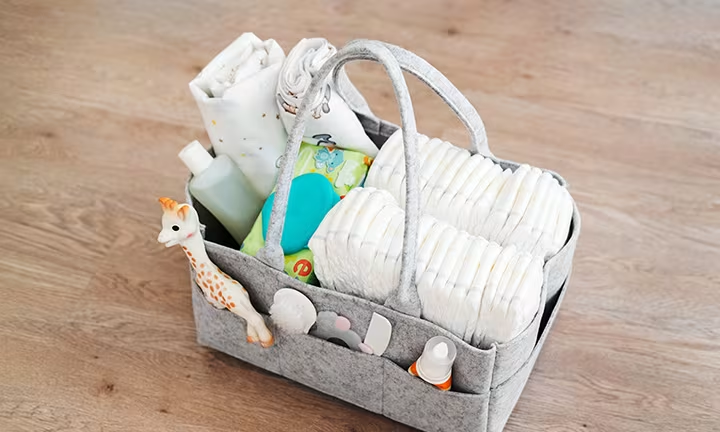
Your Essential Nappy Caddy Guide
Looking for a way to organise your nappy-changing gear? A nappy caddy is a practical option for keeping all the essentials within easy reach for changes.
Read more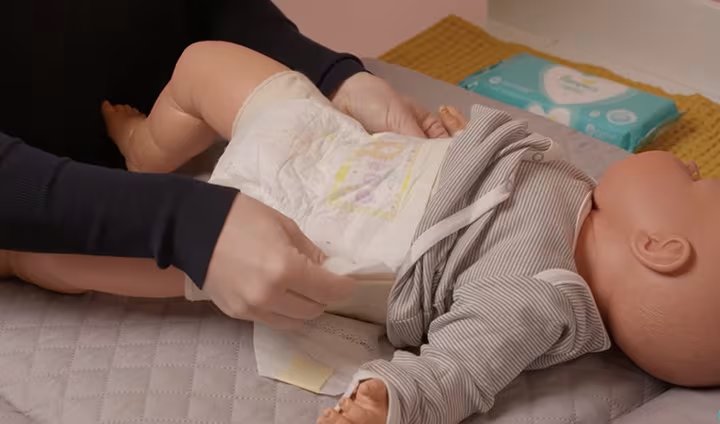
How to Change a Nappy: A Step-by-Step Guide
Learn how to change a nappy step by step, how often to change it and how to prevent leaks. Get expert tips for newborns, toddlers and nappy rash care.
Read more
When and How to Use Nappy Cream for Your Baby
Wondering about the uses of diaper creams? We’ll discuss when to use a diaper cream and provide a step-by-step guide on how to apply it.
Read more
How Many Newborn Nappies Do I Need?
While preparing for your baby’s arrival, you might ask yourself the question, 'How many newborn nappies do I need? ' We’ve got the answer and more!
Read more
How to Properly Dispose of Nappies
Nappy disposal is easy, but not as simple as tossing a used nappy in the bin. Learn our top tips for the proper disposal of nappies at home and in public.
Read more
How Often to Change a Newborn’s Nappy
Unsure how often to change your baby’s nappy? Get guidance based on age and stage to help keep their skin dry and happy.
Read moreYour Essential Nappy Caddy Guide
Looking for a way to organise your nappy-changing gear? A nappy caddy is a practical option for keeping all the essentials within easy reach for changes.
Read moreHow to Change a Nappy: A Step-by-Step Guide
Learn how to change a nappy step by step, how often to change it and how to prevent leaks. Get expert tips for newborns, toddlers and nappy rash care.
Read moreWhen and How to Use Nappy Cream for Your Baby
Wondering about the uses of diaper creams? We’ll discuss when to use a diaper cream and provide a step-by-step guide on how to apply it.
Read moreHow Many Newborn Nappies Do I Need?
While preparing for your baby’s arrival, you might ask yourself the question, 'How many newborn nappies do I need? ' We’ve got the answer and more!
Read moreHow to Properly Dispose of Nappies
Nappy disposal is easy, but not as simple as tossing a used nappy in the bin. Learn our top tips for the proper disposal of nappies at home and in public.
Read moreHow Often to Change a Newborn’s Nappy
Unsure how often to change your baby’s nappy? Get guidance based on age and stage to help keep their skin dry and happy.
Read moreYour Essential Nappy Caddy Guide
Looking for a way to organise your nappy-changing gear? A nappy caddy is a practical option for keeping all the essentials within easy reach for changes.
Read moreHow to Change a Nappy: A Step-by-Step Guide
Learn how to change a nappy step by step, how often to change it and how to prevent leaks. Get expert tips for newborns, toddlers and nappy rash care.
Read moreJoin Pampers Club and get:
- PAMPERS COUPONS
- TOOLS & QUIZZES
- PARENTING TIPS
 PAMPERS COUPONS
 TOOLS & QUIZZES
 PARENTING TIPS