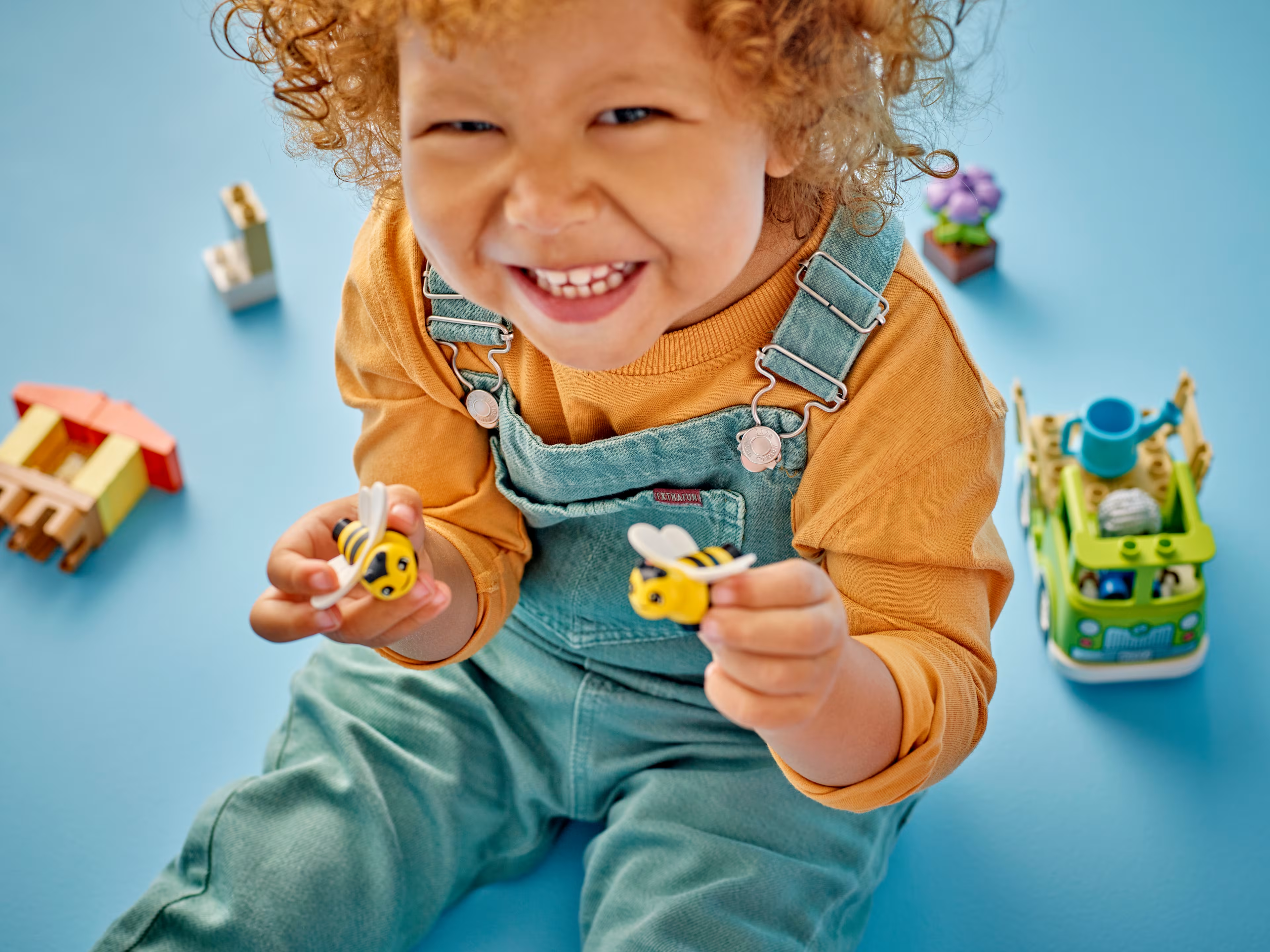
Playing With Your Baby: Why Simple Everyday Play Is Enough

Key Takeaways
Playing with your baby can be as simple as returning a smile, copying a sound, singing during a nappy change or splashing together at bath time. Small, responsive moments help babies explore, communicate and feel close to you.
Yet many parents worry they’re not doing enough. In the Pampers Baby Report, 84% of parents across Europe say early play is very or extremely important for their baby’s development, while 49% of UK parents feel guilty about not playing enough or not playing correctly, compared with 40% across Europe – one of the highest levels of play guilt in the research.
In the UK, the Play & Bonding pillar reads 39 out of 100 (48 across Europe). This describes the support conditions around play – time, mental space, uncertainty and guilt – and is not a score of parents.
| 39/100 | 49% | 46% | 76% |
|---|---|---|---|
| Play & Bonding reading in the UK (48/100 across Europe) | of UK parents feel guilty about not playing enough or correctly (40% across Europe) | of UK parents feel confident supporting development through play – the lowest of the nine countries | of UK parents feel at least one pressure around play – the highest of the nine countries |
| 84% | 64% | 9 in 10 | 45% / 38% |
|---|---|---|---|
| of parents across Europe say early play is important | of parents across Europe feel confident supporting development through play | parents across Europe report at least one barrier to play | across Europe cite lack of time / lack of mental space or tiredness |
Why is play important for a baby’s development?
Play is one of the main ways babies learn about the world. It helps develop their social, intellectual, language and problem-solving skills.
Health professionals agree. In the Pampers Baby Report, 93% of paediatricians across Europe agree that interactive, face-to-face play in the first 1,000 days is essential for healthy baby development. The American Academy of Pediatrics also says play builds social-emotional, cognitive, language and self-regulation skills.
Much of this learning happens through “serve and return”. Your baby babbles, gestures or cries, and a caring adult responds with eye contact, words or a hug. Naming what your baby sees or does helps build language connections, even before they can talk.
Play also changes across the first 1,000 days – from shared looks and copied sounds to more active, imaginative play as your little one grows. You can follow your baby’s development month by month to see what may come next.
How does play help parents bond with their baby?
Play helps babies feel close to the people who care for them. Shared smiles, songs and cuddles build the safe, loving relationship babies need to thrive.
The AAP notes that play supports safe, stable and nurturing relationships between children and the adults who care for them. Something as simple as dancing with your baby in your arms is great for bonding.
As the Pampers Baby Report puts it, these moments matter because your baby learns that someone sees them, responds to them and plays back.
How should I play with my newborn?
Everyday moments of play matter! Play with your newborn can be as simple as talking, singing and making faces during calm, awake moments. Newborns love it when you tickle their face or count their fingers and toes.
The NHS: Baby moves guidance suggests some simple ideas:
10 ideas for everyday play with your newborn
Floor play and supervised tummy time are good ways for babies to move and explore too.
| Watch for cues: If your baby seems overwhelmed – turning away, fussing or crying – give them a break by holding them or singing quietly. |
For more ideas, try these simple games to play with your baby.
What everyday interactions count as play for babies?
Almost any shared moment can count as play – book time, bath time, getting dressed, a nappy change, a walk or a shared silly sound. A song, a cuddle, a returned smile or a few minutes on the floor all count.
This matters because not every parent feels sure about play. In the Pampers Baby Report, 64% of parents across Europe feel confident supporting their baby’s development through play, but around one in three do not. In the UK, this falls to 46%, the lowest of the nine countries surveyed. If that sounds familiar, the key message is simple: these small, responsive moments count.
How can parents turn daily routines into playtime?
Add talk, songs or simple games to things you already do each day. Changing time is a lovely moment for nursery rhymes and songs to sing together.
| Routine | Play idea | What it supports |
|---|---|---|
| Nappy change | Sing or count toes | Communication and language |
| Bath time | Splash together | Exploring and learning about the world |
| Getting dressed | Name body parts | Language connections |
| Book time | Point and pause | Serve and return, and language |
| Walk | Describe what you see | Language connections |
| Feeding | Talk and make eye contact | Serve and return, and closeness |
How much should I play with my baby each day?
There’s no set amount. The NHS suggests spending time playing with your baby every day, and short, responsive moments spread through your routines all count.
A few minutes of warm attention can be valuable. Play doesn’t need to be long, expensive or perfectly planned – a quick game of peek-a-boo or a song while you tidy up is enough.
Follow your baby’s lead. If they look tired, stop for a nap or a cuddle – rest is part of the rhythm too.
Is it normal to feel guilty about not playing enough?
Yes - guilt about playtime is very common. In the Pampers Baby Report, 49% of UK parents said they feel guilty about not playing enough or not playing correctly, compared with 40% across Europe.
Pressure is widespread too. Across Europe, 7 in 10 parents feel at least one pressure or judgement around play, rising to 76% in the UK – the highest of the nine countries. Around one in four parents across Europe have felt unsure whether they play in a beneficial way.
Often, this guilt comes from the gap between what parents want to give and what daily life allows. Work, chores, tiredness and other children all compete for time. But the warm exchanges you already share – a smile at breakfast, a song in the car – really do count.
“The strongest message on play is that it should reduce pressure, not add to it. Everyday, responsive moments are often the ones babies understand best: someone sees them, answers them and enjoys being with them. Play does not have to be time-consuming or scheduled; it can be as simple as splashing in the water at bath time.”
— Professor Natasha Kirkham, Birkbeck, University of London
How can busy parents make time to play with their baby?
Make play small and fit it into what you already do - a song at changing time or a chat on the way to childcare counts.
You’re far from alone in finding this hard. Across Europe, almost 9 in 10 parents report at least one barrier to play. Lack of time is the biggest at 45%, and 38% name lack of mental space or tiredness. In the UK, 48% of parents feel they have enough time to play with their baby. Other barriers parents mention include unwanted interruptions, limited space, lack of knowledge and not having the right toys.
On tired days, choose quiet play – a cuddle, a soft song or a returned smile. For support with broken nights, read about baby sleep and parent tiredness
Screens are part of modern parenting, and many parents use them when they need a pause or are needed elsewhere. The aim is to balance them with face-to-face moments. Across Europe, 86% of paediatricians agree that screens and digital tools are replacing baby-parent playtime.
Where screens are used, try to make them a shared activity and keep plenty of face-to-face interaction in the day. Our screen time guidance for babies and toddlers has more ideas.
Keeping your baby dry and comfortable can also help reduce avoidable interruptions to play.
How can the village help with play?
The village can support play in simple ways – whether that’s taking over a chore to free up a few calm minutes for parents, or playing with the baby themselves. It’s a lovely way for family and friends to bond with the baby, while giving parents a moment to rest or enjoy a warm coffee.
Playgroups, parent-and-baby classes and informal play with other families give babies new interactions and help parents feel less alone. Find out more about parent-and-baby groups and finding your village.
| Make it small | Make it reassuring | Make it shared |
|---|---|---|
| Short, everyday moments are enough. | Warm, responsive play counts – there’s no wrong way. | Family, friends and community can help make time for play. |
Frequently asked questions
No. Play doesn’t need to be long, expensive or planned. Babies are often just as interested in everyday objects, such as a wooden spoon or a piece of shiny fabric, as they are in toys. What matters most is you – your voice, your face and your attention.
This article provides general information and is not a substitute for medical advice. If you have any concerns about your baby's development, speak to your health visitor or GP.
Explore the Pampers Baby Report
Read the full Pampers Baby Report, see the research methodology or read the report on the Ipsos website . Explore the other chapters, from parent-and-baby groups and finding your village to baby sleep and parent tiredness and what makes the UK baby-friendly, or find more baby activities to enjoy together. Because a baby learns they are loved when someone sees them, responds and plays back.