The Pampers Baby Report - The Village Barometer

Executive summary
The Pampers Baby Report Village Barometer is a new way to understand the support around babies in their first 1,000 days. Built from a major Europe-wide research programme conducted by Ipsos in April 2026, with 4,339 parents and 425 paediatricians across nine countries, and informed by further statistical review conducted by UNICEF Innocenti, it brings together 15 indicators across five support conditions around babies: Connection and Support, Confidence and Clarity, Rest and Recovery, Play and Bonding, and Baby-Friendly Futures.1,2
Based on this research, the 2026 Village Barometer result for support around babies is 58 out of 100. That result is a starting point rather than a verdict, and its value comes from the picture it opens up across all five support conditions. It shows a village that is there, but uneven. Many parents feel supported, many often or always feel happy and confident as parents, and many recognise babies’ needs in the first 1,000 days. At the same time, many are navigating loneliness, tiredness, information overload, pressure around play and milestones, and doubts about whether everyday life has been designed with babies in mind.1
The report looks at the conditions around babies and asks whether parents and the wider village have the confidence, clarity, rest, connection and practical support that can make responsive everyday care easier. Rather than judging parents, ranking families or measuring baby development directly, it offers an informed, data-based and kind picture of babies and their parents in Europe today, created to help understand the support systems around them and where further support may be needed.
Its message is hopeful and practical. Babies do not need perfect parents or perfect homes. They need warm, responsive care, supported moments of connection and a village that helps the people around them feel less alone, less judged and better able to respond.
Strengthening that village means making trusted guidance easier to find, helping families support rest, finding ways to support development through play and making sure babies are considered in the places, services, products and decisions that shape family life.
Rather than asking parents to do more, the Barometer asks what the village can do better.
The first 1,000 days need a village
A baby’s first 1,000 days are a period of rapid growth, beautiful learning, ongoing discovery and strong connection. From pregnancy through the first two years, babies are developing foundations for later physical health, communication, relationships and cognitive development. The phrase ‘the first 1,000 days’ is widely used across academic and policy literature, and research has looked at this period from several angles, from pregnancy into early childhood, early neurodevelopment and the nurturing care that surrounds young children.3,4,5,6
Put simply, once a baby’s primary needs are being met, this report keeps returning to three everyday needs parents know well: love, sleep and play. Babies need loving, consistent caregivers, peaceful chances to rest, and playful moments that help them explore the world and feel close to the people around them.
That evidence should encourage support and not pressure. The first 1,000 days are an important foundation, while still giving parents room to be human rather than optimise every moment or get everything right. Babies do not need a perfect home, a perfect routine or constant stimulation. They need good-enough, consistent and responsive care within a healthy, safe and nurturing environment, and they need the adults around them to have enough support to notice, respond and recover.
“The first 1,000 days are an important foundation for child health and development, but they should not be a source of pressure for parents. Babies need nurturing, responsive care and early stimulation in a safe and supportive environment to thrive.”
— Chemba Raghavan, Global Lead, Early Childhood Development, UNICEF
This is why a baby-first report cannot only ask what parents are doing. It also needs to ask what surrounds them. Babies experience the world through the people who hold, feed, change, comfort, play with and respond to them, and those people are shaped by their own support: whether they feel rested enough to cope, especially when a full night’s sleep feels like a distant memory; confident enough to trust themselves; clear enough to navigate advice; and connected enough to ask for help before worries grow heavier.
The word “village” helps make this support environment visible. A village is not only grandparents or neighbours, and it is not a nostalgic idea of family life. Today’s village includes parents, partners, relatives, friends, healthcare professionals, childcare settings, communities, digital tools, brands, workplaces, public spaces and wider systems. Some parts of that village are close and human. Some are professional. Some are digital. Some are practical, such as a changing space that works, a product that reduces avoidable disruption, or guidance that is simple enough to use at 3am.
The Village Barometer uses our research to look at the support conditions parents describe around babies in a European context. It starts from a simple idea: babies grow through care, and care is easier to give when the people around babies are supported. That is why the Barometer looks beyond individual parenting behaviours to the wider conditions that shape everyday care, including connection, confidence, rest, play and the way daily life is organised around babies.8
“Babies do not develop in isolation. They grow through repeated, responsive interactions with the people around them, and those interactions occur more naturally and more easily when caregivers are supported, confident and able to respond.”
— Professor Natasha Kirkham, Birkbeck, University of London
Harvard’s Center on the Developing Child describes ‘serve and return’ as the responsive back-and-forth between a young child and a caring adult, a pattern that helps build brain architecture, language and social skills. In the everyday life of a baby, that can look very small: a sound answered, a smile returned, a wriggle noticed, a song repeated. The science is significant, but the action is often beautifully ordinary.10
The Village Barometer has been created to describe the environment around those ordinary moments. It brings parent and healthcare professional evidence into a first dashboard of support conditions, showing how the village around babies feels today and where everyday support could be strengthened. That makes the Barometer a starting point for a constructive conversation: not what more should parents do, but what could the village do better?
How the village around babies has changed
Every baby begins life by reaching out. A look, a cry, a wriggle, a smile, a hand opening and closing around a finger. Long before a baby has words, they are already asking the world around them to notice, respond and come close.
For generations, that response has never come from parents alone. Babies have always grown within a village, made up of the people, routines, places, advice and everyday care that surround a family. Today, that village is still there, but it looks and feels different. Families may live further from relatives, work and childcare patterns can be harder to balance, healthcare systems can feel stretched and advice is everywhere, especially online.7,11,12,13
In our research, most parents believe they have a village and six in ten feel supported overall. That is a reassuring starting point because it shows that many babies are surrounded by people who care. The picture is uneven, however. Parents’ ideal village is bigger than the support they experience in reality: the average expected village includes 3.4 types of support, compared with 2.8 in real life. Neighbours, community groups and healthcare professionals are all less present in the real village than parents expect, while many parents rely heavily on themselves, their partner and immediate family.1
The role of digital support in today’s village
Digital support is now part of family life. It can provide reassurance, peer solidarity and quick access to ideas, especially when a parent is awake in the night or looking for a simple answer. It can also add noise when parents meet too many sources, conflicting advice or unclear trust signals. A stronger village treats digital support as one layer of help, connected to human and professional support rather than replacing it.
The changed village also means the Barometer should be read as a picture of support conditions. It is about where babies and parents already feel held by the village, and where everyday support could feel warmer, clearer and easier to reach.
“A barometer is useful because it brings structure to diverse evidence. The key is to treat it as a picture of support conditions at this point in time, not as a causal index or a ranking of parents or families.”
— Gwyther Rees, UNICEF Office of Strategy and Evidence – Innocenti
Family structure should also be handled with care, because babies can be surrounded by love, connection and responsive care in many different family shapes. What helps is the presence of support that reaches parents before they feel alone, overburdened or unsure where to turn, whatever shape their family takes.
That is the role of the Pampers Baby Report Village Barometer: to look at the conditions around babies in their first 1,000 days, and to understand where the modern village feels strong, where it feels stretched and where families need more confidence, care and reassurance.
How the Baby Village Barometer works
The Village Barometer is based on a Europe-wide survey conducted by Ipsos in April 2026, listening to 4,339 parents and 425 paediatricians across nine countries about what babies need, how families are supported and where the modern village feels strong or stretched. The findings were reviewed alongside statistical analyses conducted by UNICEF Innocenti, looking across indicators such as support, happiness, confidence, sleep, play, information, loneliness and future worries.1,2
The survey was conducted by Ipsos in April 2026 asking about support, happiness, confidence, sleep, play, information, loneliness, digital support, future worries and perceptions of the village around babies. The Barometer uses 15 selected survey indicators, reviewed alongside statistical analyses conducted with UNICEF Innocenti, to create a high-level picture of support conditions around babies. It is designed as a descriptive dashboard, not as a clinical measure of child development, a judgement of parents or a country ranking.
Those indicators were grouped into five pillars. Each pillar shows a different part of the support environment around babies in their first 1,000 days. Some indicators are positive, such as whether parents feel supported, happy or confident. Others are pressure indicators, such as loneliness, tiredness, information overwhelm or worry about the future. To make the reading simple, every indicator is converted so that a higher score always means a stronger support condition around the baby. The pillar readings should be understood as a descriptive view of each support condition, rather than as a statistical ranking between pillars. Future waves of this research may refine or deepen individual indicators, but this first reading gives the village a clear baseline from which to learn.
For example, if 65% of parents say they have a village, that contributes 65 to the Connection and Support pillar. If 44% of parents say they feel lonely at least sometimes, the positive score becomes 56, because 56% are not reporting loneliness at that level. The Barometer then averages the indicators within each pillar, and the five pillar scores create the overall reading.
| Pillar | Score | What it tells us | Main tension |
| Connection and Support | 60 | Many parents feel supported or say they have a village. | Support is not reaching everyone equally. |
| Confidence and Clarity | 71 | Most parents often or always feel happy and confident, but guidance can still feel noisy. | Information should reassure, not overwhelm. |
| Rest and Recovery | 53 | Sleep disruption and tiredness are common, and rest is part of the care environment. | Families need help supporting recovery as well as routines. |
| Play and Bonding | 48 | Parents value play, while time, pressure and confidence shape the support conditions around it. | Everyday play should feel like connection, not performance. |
| Baby-Friendly Futures | 56 | Parents are thinking beyond daily care to the world their baby will grow into. | Systems, spaces and services need to feel more designed around babies. |
The value is not so much about any single number than about the wider picture the Barometer helps us see. Like a dashboard, it is most useful when the five support conditions are read together, showing where the village already helps parents and babies, and where the conditions around everyday care can be strengthened. The pillar readings help structure the story, but they should not be read as a league table of which areas are statistically stronger or weaker than others.
Village stories, not country rankings
The country stories in this report are not a ranking of places to have a baby, or a judgement on parents in one country compared with another. They show how different parts of the village feel across Europe: where support appears more visible, where pressure feels sharper, and where everyday life may feel more, or less, designed around babies.
What a stronger rest village looks like
| Make it normal | Make rest possible | Make it shared |
| Parents need reassurance that babies wake for many ordinary reasons, especially in the early months when sleep cycles are short and rhythms are still developing. | The village can help families create calmer routines, support chances to rest and reduce avoidable wake-ups linked to wetness, discomfort or leaks. | Rest becomes easier to support when partners, family members and supporters respond to tiredness with practical help, not judgement. |
When the village supports rest, it helps make the night feel less lonely and gives babies and parents a little more space for the closeness, comfort and calm that carry them into the next day.
Play and Bonding: making space for everyday moments of connection
| 48/100 | 64% | Almost 9 in 10 | 7 in 10 |
| Play and Bonding score | Of parents feel confident supporting development through play | Parents report at least one barrier to play | Parents experience at least one pressure around play |
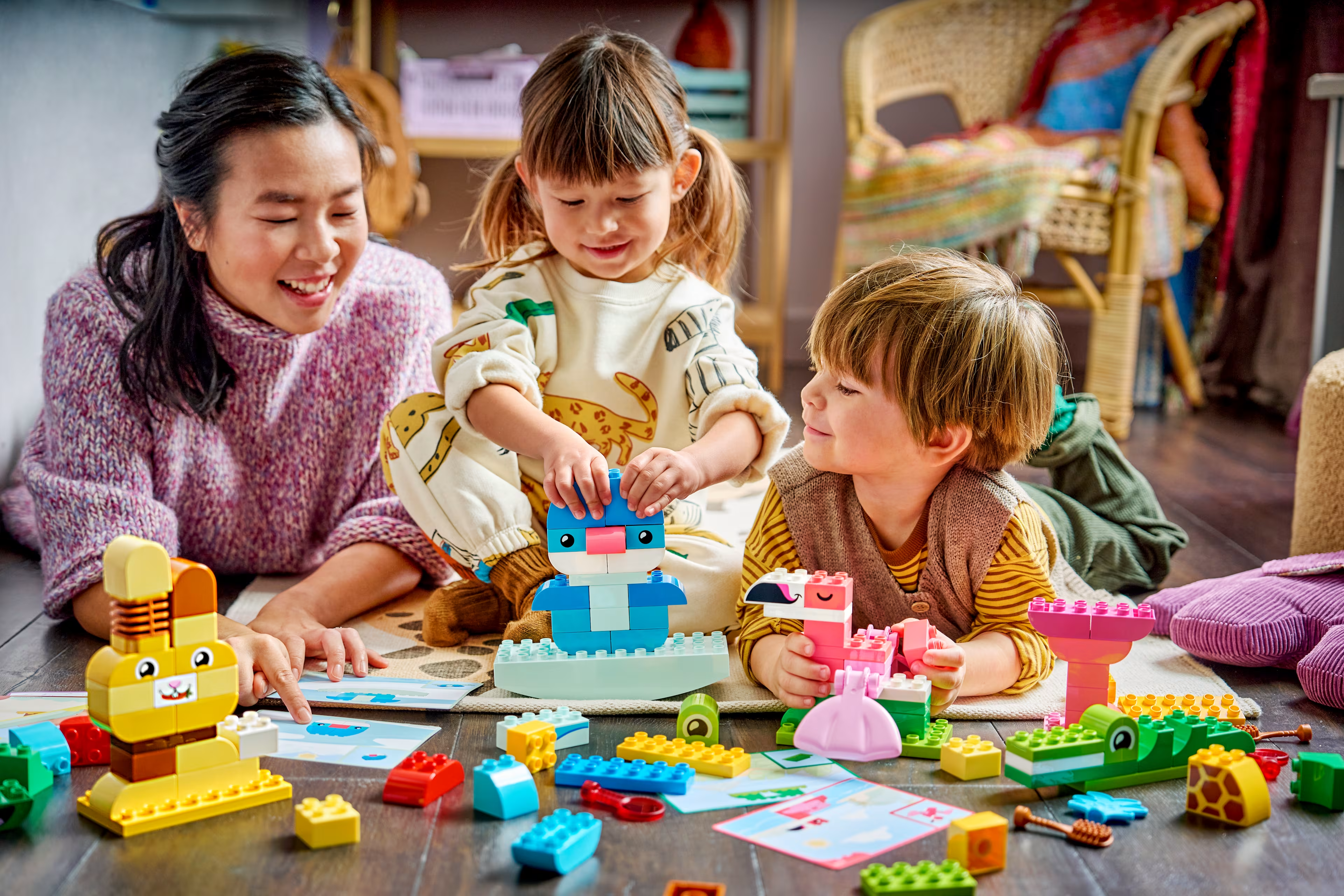
There is something magical about watching a baby discover the world. A hand reaching out. A smile returned. A curious exploration of communication through babbling. To a grown-up, these can look like tiny moments. To a baby, they are busy workouts for the brain, the body and the bond they are building with the people around them.
The science supports the instinct parents already have. Harvard’s Center on the Developing Child describes serve and return as responsive back-and-forth interaction between a young child and a caring adult. The American Academy of Pediatrics also describes play as a route through which children build social-emotional, cognitive, language and self-regulation skills, and highlights a role for pediatricians in encouraging playful learning.10,19
Play also changes quickly across the first 1,000 days. The shared look, copied sound or peek-a-boo moment that delights a young baby gradually becomes more active, imaginative and exploratory as a toddler grows. The form changes, but the heart of play remains the same: a baby or young child notices the world, tries something out and finds someone there to notice and respond with them.
That is why play sits at the heart of the Village Barometer as one of the everyday ways babies connect, learn and feel close to the people who love them, rather than another thing for parents to get right or a chore to schedule in the day. Our research shows that many parents already feel confident supporting their baby's development through play: 64% say they feel confident. At the same time, almost nine in ten parents report at least one barrier to play, showing why support around play matters as much as confidence itself.1
The Play and Bonding pillar has a reading of 48 out of 100. The reading should be understood as a picture of the support conditions around play, especially where time, mental space, uncertainty and guilt make play feel harder than it should. Many parents feel confident supporting their baby’s development through play, but around one in three do not, which is why simple, reassuring ideas can help.1
Village story: where play feels confident or squeezed
Germany stands out for parents feeling confident supporting their baby's development through play, with 83% saying they feel confident, compared with the European average of 64%. Time tells another story. In Romania, 64% of parents say they have enough time for meaningful play, compared with 43% in France. These examples show how families need space, encouragement and permission to enjoy simple moments of connection.
The difficulty is that play can start to feel like performance. Seven out of ten parents experience at least one pressure or judgement around play. Four in ten have felt guilty about not playing enough or not playing correctly, and around one in four have felt unsure whether they are playing in a beneficial way. The tension is understandable: the more parents understand the benefits of play, the more sharply they may feel the gap between what they want to give and what daily life allows.1,21
Research from the LEGO Group helps bring this story into focus. It points out that play needs head space as well as time, and that the ordinary distractions of modern life, including chores, notifications, phone calls and digital habits, can make it difficult for parents to feel fully present even when they are physically with their baby.21
The LEGO Group’s Play Well Study, based on parents of children aged 1 to 12, also points to the family value of play beyond the baby years. In that study, nine in ten parents agreed that playing as a family facilitates better communication between them and their child and helps their child make sense of the world. Among parents of children aged 1 to 5, those figures remained very high, at 93% and 92% respectively.26
The same study suggests that family play does not need to take over the week to be meaningful. Wider LEGO Play Well research describes five hours of family play a week as a positive tipping point for family happiness and wellbeing, based on comparisons with families playing for under two hours. Because that evidence comes from wider family research, rather than a baby-only study, it should be read as supportive context rather than a new target for parents in the first 1,000 days. The useful message is not that every family must reach a fixed number of hours, but that regular, achievable moments of play can help family life feel more connected.26
Uninterrupted play matters
Many moments of play happen alongside the realities of family life: chores, siblings, notifications and everything else competing for parents' attention. Some interruptions are simply part of everyday parenting. Others can be reduced. When play is interrupted because a baby needs changing after a leak or becomes uncomfortable, it breaks the flow for both baby and parent. Helping babies stay dry and comfortable can reduce avoidable interruptions, giving families more opportunity to enjoy those small, responsive moments of connection.
Play is so many different things
Without a clear sense of what “good” play looks like, parents can feel pressure to create special activities or set aside extra time they may not have. It can help to see play as an attitude and approach that can be woven through many ordinary moments: book time, bath time, getting dressed, cooking nearby, walking to childcare, a nappy change or a shared silly sound.
Village story: where play feels pressured
Greece offers a useful counterpoint on play pressure, with 29% of parents saying they feel guilty about not playing enough or not playing correctly, compared with the European average of 40%. UK parents report one of the highest levels of guilt at 49%. The contrast reinforces the report's message that play should feel like connection with a baby, not another performance measure for parents.
This reframing is helpful because parents do not need play to become another source of guilt. Some may need simple ideas for how to start, while others may need permission to count the warm, responsive exchanges they are already having. In our research, lack of time is the biggest reported barrier to quality playtime, followed by lack of mental space or feeling too tired or stressed, while other parents point to unwanted interruptions, limited space, lack of knowledge or not having the right toys or materials.1,21
Screens without blame
Screens are part of 2020s parenting, and many parents use them when they are needed elsewhere, need a pause, or simply need to get through the next few minutes. The aim is not to blame parents for using screens, but to help families balance them with reassuring, face-to-face moments that babies can respond to directly.
Digital tools can provide ideas when parents want inspiration, but the expert view is clear that face-to-face interaction has a special place in the first 1,000 days. Among pediatricians in our research, 93% agree interactive, face-to-face play in the first 1,000 days is essential for healthy development, while 86% agree screens and digital tools are replacing baby-parent playtime. Yet play and interaction barely appear as a reason for non-routine pediatric appointments, creating a quiet conversation gap between what experts see as valuable and what parents may feel able to raise.1
The power of social play
Play can also help rebuild the village around parents. Playgroups, parent-and-baby classes, community spaces and informal play with other families can give babies new interactions and give parents the feeling that they are not doing this alone. When play becomes shared, it can support connection for the grown-ups as well as the baby.
“The strongest message on play is that it should reduce pressure, not add to it. Everyday, responsive moments are often the ones babies understand best: someone sees them, answers them and enjoys being with them. Play does not have to be time-consuming or scheduled; it can be as simple as splashing in the water at bath time.”
— Professor Natasha Kirkham, Birkbeck, University of London
What a stronger play village looks like
| Make it small | Make it reassuring | Make it shared |
| A few minutes of warm, responsive attention can be valuable. Play does not need to be long, expensive or perfectly planned. | Parents need confidence that simple games, songs, cuddles, copycat sounds and everyday moments count. | The village can help by creating time, ideas, community spaces and permission, not judgement. |
When the village makes space for play, it supports one of the simplest ways babies learn they are loved: someone sees them, responds to them and plays back.
Baby-Friendly Futures: making the world around babies easier to grow into
| 56/100 | 42% | 35% | 44% |
| Baby-Friendly Futures score | Parents feel society is not designed with babies in mind | Parents worry about their baby’s future | Would consider having another child |
Every parent thinks beyond today. Even in the middle of feeds, changes, naps and night waking, there is a bigger question sitting quietly in the background: what kind of world is my baby growing into?
The Baby-Friendly Futures pillar scores 56 out of 100. At its centre is whether parents feel society is designed with babies in mind, because that question speaks directly to the everyday world babies and families move through. The pillar also includes wider signals of the emotional climate around early parenthood, including future worry and openness to having another child, which are best understood as contextual indicators rather than direct measures of a baby’s prospects.1
In our research, 42% of parents agree that society is not designed with babies in mind. That is not only about formal policy. It is about everyday details: spaces that are easy to use, services that are simple to access, workplaces that understand family life, products that reduce friction and public conversations that respect the importance of the first years.1
Village story: where the future feels baby-friendly or uncertain
Spain shows why baby-friendly futures are important, with 50% of parents agreeing that society is not designed with babies in mind, compared with 42% overall. Greece has the highest level of future worry, at 53%, while the United Kingdom is lowest on that measure, at 17%. These signals show how strongly the wider world can shape the emotional climate around early parenthood.
The wider evidence points in the same direction. Early childhood is shaped not only by what happens inside the home, but by the relationships, environments, services and systems around a child. The Royal Foundation and Deloitte report describes early childhood through a social-ecological lens, recognising that family, community, services, employers, products and policy all influence the conditions around young children. The Nurturing Care Framework makes a similar point through the idea that responsive caregiving, health, nutrition, safety, security and early learning are supported by the systems around families.8,13
Wider early-years research also shows that support for families is shaped by more than individual care. Access to affordable, high-quality early childhood education and care, family-friendly work and joined-up services can help parents balance family life and paid work, while strengthening the conditions for nurturing, responsive interactions with young children.25
“Parents do not raise children in isolation. Policies, services, and support systems shape the conditions that enable parents to provide nurturing care to their young children.”
— Chemba Raghavan, Global Lead, Early Childhood Development, UNICEF
Village story: where practical priorities differ
Poland helps show that baby-friendly futures are not shaped by one pressure alone. In Poland, financial support is a less dominant priority than in some other markets, with 31% of parents saying it would make the biggest difference, compared with the European average of 40%. The wider message is that families across Europe may need different kinds of help, but the shared need is for daily life to feel more supportive around babies.
Future worry is not a direct measure of a baby’s prospects, and it should not be used to suggest that parents are pessimistic. It is better understood as part of the emotional climate around early parenthood: a signal that parents are thinking beyond today and asking whether the world around their baby will be supportive enough. The same care applies to another-child consideration, which sits here as a wider signal about confidence in family life rather than as a direct baby outcome.
What a stronger baby-friendly village looks like
| Make babies visible | Make daily life easier | Make responsibility shared |
| A baby-friendly future starts by recognising babies in decisions about services, spaces, transport, workplaces and community life. | Families need practical conditions that reduce friction, from accessible places to feed and change a baby to services and routines that reflect real baby care. | The first 1,000 days should not sit on parents’ shoulders alone. A stronger village treats babies’ early years as something communities, services and society help to support. |
When the village becomes more baby-friendly, it gives families more than practical ease. It gives parents the feeling that their baby belongs in the world, and that the world is prepared to make room for them.
Building a stronger village for every baby
The first reading of the Pampers Baby Village Barometer gives us a hopeful and honest picture. The village around babies is there. Parents are loving, committed and deeply aware of what their babies need. Healthcare professionals see the value of early interaction, sleep, care, play and support. Families are finding help from partners, relatives, friends, communities, professionals and digital sources.
The picture is uneven with plenty of scope for improvement. Support does not reach everyone in the same way. Advice can overwhelm, rest can feel fragile, play can feel insufficient and everyday life can make caring for a baby feel harder than it needs to be. These are not failures of parents; they are signs that the support conditions around babies can be strengthened.
A stronger village starts with connection. That means helping parents feel they have people they can turn to before worries grow heavier, and recognising that support can be emotional, practical, informational and professional. It also means keeping the message non-judgemental: babies can be loved and cared for in many different family shapes, and the question is whether the people around them have the support they need to respond.
A stronger village also needs clearer guidance. European parents live in an advice-rich world, but more information is not always more helpful. The research highlights the value of guidance that is trusted, simple and confidence-building, especially when parents and healthcare professionals are seeing the same challenge from different sides: parents feeling overwhelmed by the volume of information, and professionals seeing how too many sources can add pressure rather than reassurance.1,12,15
Village story: what the country stories tell us
Across the nine countries, every village has strengths and challenges. Italy shows visible support, Germany play confidence and Sweden lower information overwhelm, while France, the UK, Romania, Greece, Spain and Poland show different pressure points. Together, they remind us that the village is not one thing. It is the care, clarity, rest, play and practical support that make everyday life gentler around babies.
Rest belongs within the care environment, rather than being treated as a private problem for tired families to solve alone. Babies will wake, and no report should suggest otherwise. A stronger village helps parents understand normal baby sleep, supports recovery where possible and reduces avoidable disruption through comfort, dryness, calm routines and shared support.16,17,18
Play is best understood as connection rather than performance. Parents already understand that early play is valuable, but they do not need another standard to meet. For the third of parents who do not feel confident supporting development through play, the most useful message is that small, responsive moments count: a song, a cuddle, a returned smile, a copied sound, a few minutes on the floor, or a moment of face-to-face attention during an ordinary part of the day.10,19,20,21
Baby-friendly futures need babies to be visible in everyday decisions. Families notice whether public spaces work, whether services feel joined up, whether work patterns leave room for care, and whether products and guidance reduce friction or add to it. These are not abstract issues; they shape how easy or difficult early care feels in daily life, even when the detail of policy is kept outside the scope of this report.8,13
Where brands can help
Brands cannot replace families, healthcare professionals or public services. Their role is to contribute responsibly: by listening to parents, sharing evidence-led guidance, designing products that reduce everyday friction and helping keep babies visible in public conversations about early life.
Pampers has a credible role because it is already part of the daily rhythm of baby care: the sleepy change, the fresh start, the wriggle on the mat, the night-time cuddle and the dry, comfortable baby who can settle back down. The Village Barometer helps make the conditions around those moments visible. It gives Pampers a way to convene a positive conversation about what babies need from the village around them.
Rather than pointing to one solution, the research highlights a series of practical shifts: closer support, clearer guidance, support for rest, lower-pressure play and a wider world that makes babies visible in daily life. When the village becomes warmer, clearer, calmer, more playful and more baby-friendly, it helps babies feel held by more than one pair of hands. It helps parents feel less alone. And it helps the first 1,000 days become what they should be: a time of care, connection and possibility.
“The first 1,000 days are an important opportunity to support children’s development. The focus should be on helping families provide nurturing care in a supportive environment, not on creating anxiety about missed moments.”
— Chemba Raghavan, Global Lead, Early Childhood Development, UNICEF
1. Pampers. Baby Village research. Ipsos for P&G Pampers; 2026.
2. UNICEF Innocenti. Pampers Baby Report 2026 selected emerging findings and statistical review. Unpublished analysis prepared for P&G Pampers; 2026.
3. Koletzko B et al. Nutrition during pregnancy, lactation and early childhood and its implications for maternal and long-term child health: the Early Nutrition Project recommendations. Ann Nutr Metab. 2019;74(2):93-106.
4. Dan B. The first 1000 days: a critical window for neurodevelopmental trajectories and interventions, and for parents. Dev Med Child Neurol. 2025;67(9):1108-1109.
5. Britto PR et al. Nurturing care: promoting early childhood development. Lancet. 2017;389(10064):91-102. doi:10.1016/S0140-6736(16)31390-3
6. Suri S et al. The first 1000 days: window of opportunity for child health and development. Front Nutr. 2025;12:1673003.
7. UNICEF. Early Moments Matter for Every Child. UNICEF; 2017. Accessed June 18, 2026. https://www.unicef.org/reports/early-moments-matter-every-child
8. World Health Organization et al. Nurturing Care for Early Childhood Development: A Framework for Helping Children Survive and Thrive to Transform Health and Human Potential. World Health Organization; 2018. ISBN:9789241514064.
9. UNICEF. Early childhood development. Accessed June 18, 2026. https://www.unicef.org/early-childhood-development
10. Center on the Developing Child at Harvard University. Serve and Return. Accessed June 18, 2026. https://developingchild.harvard.edu/key-concept/serve-and-return/
11. Henton S et al. A mixed-methods analysis of the role of online social support to promote psychological wellbeing in new mothers. Digit Health. 2023;9:20552076221147433. doi:10.1177/20552076221147433
12. Opie JE et al. Universal digital programs for promoting mental and relational health for parents of young children: a systematic review and meta-analysis. Clin Child Fam Psychol Rev. 2024;27:23-52. doi:10.1007/s10567-023-00457-0
13. Deloitte. Prioritising Early Childhood for a Happier, Healthier Society: How Businesses Can Drive, and Benefit from, Transformative Change in the UK. Report for The Royal Foundation of The Prince and Princess of Wales on behalf of The Business Taskforce for Early Childhood; 2024.
14. Naughton-Doe R et al. Exploring perinatal loneliness as a key social determinant of perinatal mental ill health in the UK: findings from a multidisciplinary consensus statement. BMJ Open. 2025;15:e085669. doi:10.1136/bmjopen-2024-085669
15. Glatz T et al. Is more information always better? Associations among parents’ online information searching, information overload, and self-efficacy. Int J Behav Dev. 2023;47(5):444-453. doi:10.1177/01650254231190883
16. Pampers. Sleep Science Guide. Reviewed and approved by Madeleine Grigg-Damberger. P&G Pampers; 2025.
17. Bai L et al. Maternal sleep patterns and parenting quality during infants’ first 6 months. J Fam Psychol. 2020;34(3):291-300. doi:10.1037/fam0000608
18. Bai L et al. Maternal nighttime sleep and infant-mother attachment security: the mediating role of maternal parenting quality during bedtime and free play. Dev Psychol. 2022;58(5):923-934. doi:10.1037/dev0001327
19. Yogman M et al. The power of play: a pediatric role in enhancing development in young children. Pediatrics. 2018;142(3):e20182058. doi:10.1542/peds.2018-2058
20. Whitebread D et al. The Role of Play in Children’s Development: A Review of the Evidence. The LEGO Foundation; 2017. ISBN:978-87-999589-3-1
21. The LEGO Foundation. Baby Report insights summary. Unpublished contribution prepared for the Pampers Baby Report; 2026.
22. Williams CL et al. Parent attention-orienting behavior is associated with neural entropy in infancy. Infancy. 2025;30(1):e12595.
23. Kadiroğlu T et al. Effect of infant care training on maternal bonding, motherhood self-efficacy, and self-confidence in mothers of preterm newborns. Matern Child Health J. 2022;26(1):131-138. doi:10.1007/s10995-021-03287-0
24. Leitão C et al. Promoting family wellbeing through parenting support in ECEC services: parents’ views on a model implemented in Ireland. Front Educ. 2024;9:1388487. doi:10.3389/feduc.2024.1388487
25. UNICEF Regional Office for Europe and Central Asia. Foundations for the Future: Strengthening Early Childhood Education and Care Systems for Ages 0–3 in Europe and Central Asia. UNICEF; 2024.
26. LEGO Group. Data from the LEGO® Play Well Study 2026, commissioned by the LEGO Group and carried out by Edelman DXI, with insights from 45,000 respondents across 30 markets between December 2025 and January 2026. Respondents included 30,000 parents with children aged 1–12 years old, and 15,000 children aged 5–12. Internal report; April 2026.